
So right at the start I must warn you this might, no, will get icky.
On the road to Santiago de Compostella we meet all sorts of people, lots of different animals (farm animals: cows mostly, sheep, farm dogs that either sleep or bark), wild animals: deer, lizards and snakes (the two I have seen have been dead, not skilled in navigating traffic unfortunately) and then there are all the different insects. Butterflies like ones we have at home: Cabbage Whites, Red Admirals, and then there are medium sized brown ones with little orange dots over all their wings, bright yellow ones that move really fast and then moths too. There are grasshoppers or crickets with blue or pink wings under their sandy camouflage, I’ve seen the occasional katydid, then there’s dragonflies with iridescent bodies. There are the ubiquitous flies that buzz all round you as you get hot walking in the afternoon. I had one or two actually get behind my sunglasses and into my eye. I got used to mopping my brow, taking my hat off and swiping at them, it might have made some difference. Mosquitoes at night occasionally sought us out but I think I only got bit once or twice.
It is the other nocturnal biting insects that are really concerning. The hostels do an amazing job of cleaning the dormitories, the beds, sealing the mattresses and pillows in plastic and some even issue a paper like sheet to cover the mattresses. We brought with us man-made silkworm sheet bags that I had treated with an insecticide. They had a pouch at the top to put a pillow in but most Spanish pillows are 90cm long and didn’t fit ( I need to tell the Scots who made them). The silk like material was even meant to be impregnable to tiny insects. So bedtime was meant to be safe.
At one hostel I lifted a roll of paper in the toilet and discovered a 3mm flattish, oval insect run about on the paper. It didn’t want to jump so I took two goes at squashing it.
Mark: 1
Bugs: 0
We had slept alright (apart from the snoring and torchlight processions of early risers) that night.
Two days later we came across three lovely German girls who showed us their skin covered in red blotches. Their initial treatment cream hadn’t really helped but I suggested anti-histamine and they started taking some and got some relief.
Germans: 0
Bugs: 30+
That same day we witnessed a hostelerio assist a pilgrim in putting her rucksack in a binbag and spray something into the bag which he then sealed.
She was staying in our room…
A week earlier in Mansillas de Mulas two pilgrims took all their stuff to a laundromat and had it cleaned and dried. The hostelerio was very helpful and explained all the precautions she took to exclude the little blighters, including expecting honesty from pilgrims not silence if they think they have a problem.
It’s quite a catch 22 situation. The insects go hide in crevices in beds, skirting boards and rucksacks during the early morning after having a wee bite to eat. But they are brought there in rucksacks.
The hostels do their best to kill and exclude them with noxious chemicals and physical barriers in the form of sealed skirting and plastic covered mattresses. Pilgrims arrive at a hostel and usually shower and put on clean clothes washing their sweaty dirty ones.
But in the evening when everyone goes to bed the blighters emerge to select their targets.
As we arrived in Santiago and came to a modern hostel I showered changed into clean clothes and sat down only to discover a small insect crawl quickly over my wrist. I stopped it and squashed it leaving a splotch of blood. It had just bit me!
Mark:1
Bug:1
I spoke to the hostelerio and she helped me get my rucksack into a black plastic bag to spray it. A friend leant me clothes and I put the rest of my clothes and soft contents of my rucksack into a washing machine to wash and then dry them.
I spent the evening in my friend’s clothes while my clothes got de-infested and my rucksack was fumigated.
We visited the cathedral of Saint James the Greater, (John’s brother, son of Zebedee) to finish our pilgrimage. There was a Communion service and then a group of 8 men appeared in crimson robes and they took hold of a rope that was attached to a pillar near us in front of the altar. Six lowered it into position and one opened it an another placed a burning grate of coals and incense into the censor. The six on the end of the rope hoisted it straight up to about 2.5m where the tallest caught hold of the base and started it in a swing across the front of the altar and out towards the north entrance. It reached its zenith and started back towards the south entrance wherein the six hoisted it even higher and caused it to swing faster. The smoke billowed out of the censor as it swung back and forth over the congregation dousing us with incense.
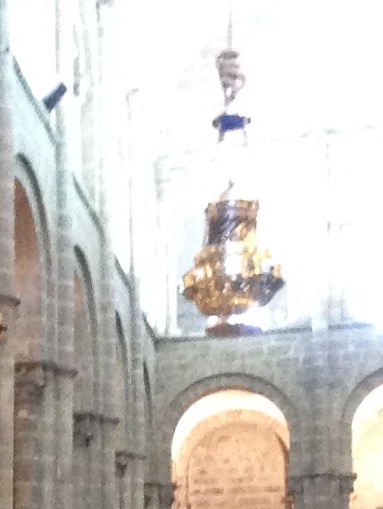
The origin of this practice seems to that when the pilgrims arrived in Santiago in medieval times they were not sweet smelling, nor has they taken showers, and they were certainly infested with all sorts of flora and fauna. So to preserve the sensibilities of the rich and elect (possibly not in the biblical sense); incense covered over a multitude of sins!
Here I was getting fumigated, but even so I was beginning to feel my skin become itchy in places, my elbows, my shoulders and most lately my back. It takes three to five days for the bites to emerge, or for your body to respond to them. Gives the critters a chance to escape or come back for another meal when you least expect.
Mark: 2
Bed bugs: 17
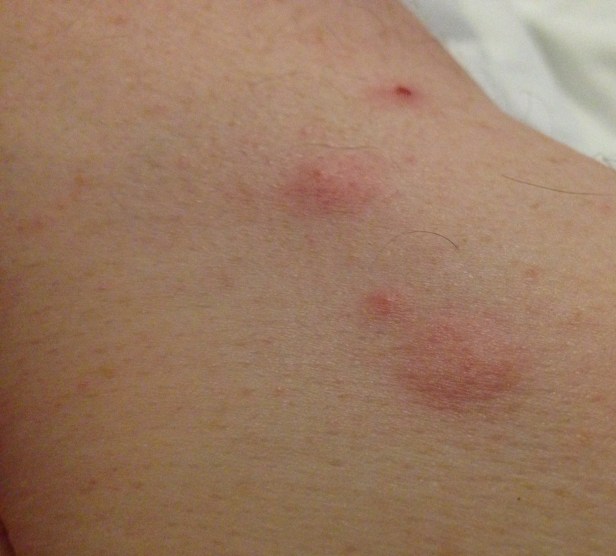
I need to see a pharmacist.
 Hearts Set On Pilgrimage